
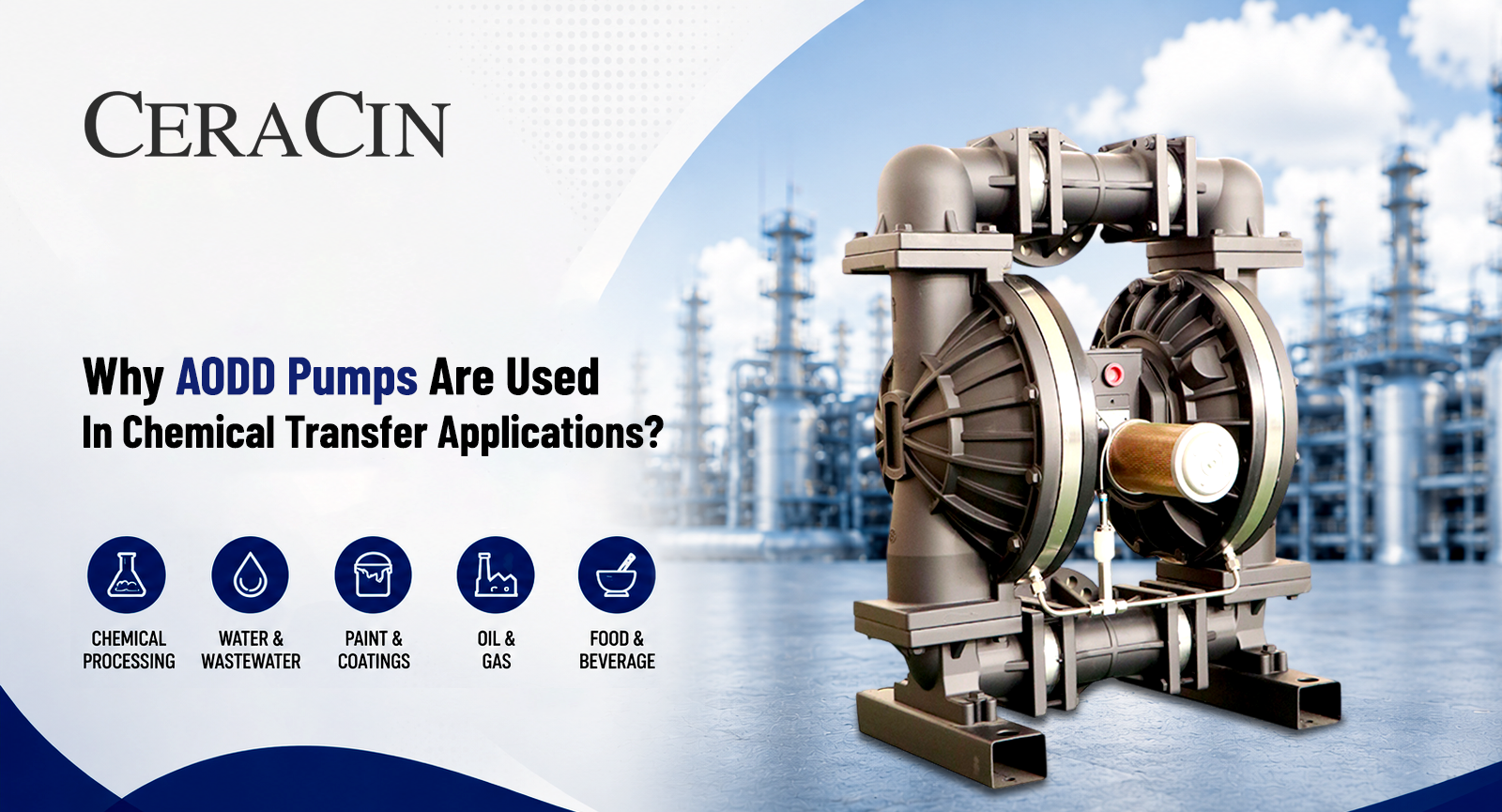
Why AODD Pumps Are Used in Chemical Transfer Applications?
Overview – Chemical transfer is one of the most demanding pump applications in any industrial setting. The fluids being moved are often corrosive, flammable, abrasive, or some combination of all three. A pump failure in this environment is not just a maintenance problem — it is a safety event. The AODD pump has become the standard choice for chemical transfer precisely because its design handles these conditions better than most other pump types.
This Blog Covers:
Introduction
An AODD pump, or air-operated double diaphragm pump, runs on compressed air rather than electricity. It has no mechanical seals, no rotating shaft exposed to the fluid, and very few moving parts. In a chemical transfer application, those three facts matter more than almost any performance specification on a data sheet.
This post explains why the AODD pump is so widely used in chemical environments, what makes it suitable for difficult fluids, and what to look for when selecting one.
How an AODD Pump Works?
The pump has two chambers, each with a flexible diaphragm. In one chamber, compressed air forces the diaphragm outward, forcing fluid through the discharge valve. At the same time the opposing diaphragm is pulled back, drawing fluid through the inlet valve. The air then switches sides, and the process repeats. The two chambers alternate their operation. This gives a steady, pulsating flow.
The fluid only ever contacts the diaphragm, the pump casing, and the ball valves. There is no shaft seal between the fluid and the outside of the pump. That sealed fluid path is what makes the AODD pump inherently leak-resistant, and it is the fundamental reason chemical processors choose it over centrifugal and other pump types.
Why It Suits Chemical Transfer Applications?
Several specific characteristics make the AODD pump the right tool for chemical transfer:
- No shaft seals. Mechanical seals are the most common failure point in centrifugal pumps handling aggressive chemicals. They wear, they leak, and when they fail in a chemical transfer application, the result can be a hazardous spill. An AODD pump eliminates that failure mode entirely by design.
- Dry run capability. Chemical sumps run low. Tankers get close to empty. Transfer lines see intermittent flow. Most pump types are damaged when run dry, but an AODD pump tolerates dry running without damage. This is one of the most practically important features in real chemical plant operation.
- Self-priming. An AODD pump does not need positive inlet pressure to prime. It can be installed at ground level next to a tank and draw fluid up to 9 metres of suction lift. No priming procedures, no foot valves, no complex installation requirements.
- Air-powered operation. An AODD pump can be safely used in hazardous or explosive environments where electrical equipment presents an ignition risk, because it uses compressed air and not electricity. This makes it ATEX compatible and suitable for the transfer of solvents, fuels and other flammable fluids.
- Dead-head tolerance. If the discharge line is closed while the pump is running, an AODD pump simply stops pumping. It does not build pressure to failure or overheat. This gives operators flexibility in process control without the risk of equipment damage.
- Solids handling. AODD pumps can pass solids up to 75mm in diameter depending on the model. In chemical slurry, pigment, and paint applications, the ability to handle suspended solids without clogging is a significant practical advantage.
- Adjustable flow rate. Flow is controlled by adjusting the air supply volume and pressure. No variable speed drive, no complex controls. The pump adjusts to the process simply and continuously.
Material Selection and Chemical Compatibility
The pump body material is what determines which chemicals it can handle. This is where the selection decision gets specific.
- PP (Polypropylene) — general-purpose acid and alkali resistance. Suited to dilute acids, caustics, and water-based chemicals at moderate temperatures.
- PVDF (Polyvinylidene fluoride) — stronger chemical resistance than PP, suited to aggressive acids, solvents, and oxidising agents including chlorine and hydrogen peroxide.
- Stainless steel — suited to hygienic applications, food-grade chemicals, and applications where temperature resistance matters more than aggressive chemical compatibility.
- Aluminium — general-purpose industrial use for non-corrosive fluids and solvents that are compatible with aluminium.
Diaphragm and ball valve material also matters. PTFE diaphragms are chemically inert across the widest range of fluids. EPDM, FKM, and Santoprene are available for specific chemical and temperature requirements. Getting the wetted material combination right is what determines whether the pump lasts or degrades quickly.
Where AODD Pumps Are Used Across Industries?
The AODD pump’s combination of chemical resistance, dry run capability, and safe air-powered operation makes it useful across a wide range of industries:
- Chemical processing — acid transfer, caustic handling, solvent transfer, polymer feeding, resin circulation, and bulk chemical unloading
- Pharmaceutical and food processing — where hygienic design and the absence of mechanical seals prevent contamination
- Paints and inks — handling viscous, pigment-loaded fluids that would clog or damage other pump types
- Mining — slurry transfer and chemical dosing in demanding site conditions
- Cement industry — transferring aggressive slurries and process chemicals
- Wastewater treatment — sludge transfer, chemical dosing, and pH correction
- Marine and fuel transfer — flammable fluid handling in environments where electrical ignition risk must be eliminated
Get in Touch
Ceracin, based in Vadodara, Gujarat, manufactures and supplies AODD pumps across PP, PVDF, stainless steel, and aluminium variants. Established in 2016, we supply chemical processors, pharmaceutical manufacturers, paint and ink producers, and a range of other industrial users across India and international markets. To discuss your application or request a quote, contact Ceracin at +91 63510 19235 or sales@ceracin
Frequently Asked Questions
Can an AODD pump handle both corrosive and abrasive fluids?
What happens if an AODD pump runs dry?
How is flow rate controlled on an AODD pump?
When should I choose PVDF over PP for a chemical transfer application?

Ceracin
Ceracin has expertise in industrial pump manufacturing since 2016. We are committed to provide our nation with the highest quality pumps at competitive prices.